What's New in Oracle Fusion Sales 26C
There's no single headline feature dominating this release. Instead, 26C is about consolidation: AI Agent Studio has picked up a long list of maturity features, a couple of genuinely useful agentic capabilities have landed in Sales Force Automation and Subscription Management, and there's a security change buried in Common Technologies that every customer needs to plan for regardless of which product they're running.
I've pulled together the features I think are worth your attention across Sales Force Automation, Sales Performance Management, Subscription Management, and Common Technologies and User Experience. As always, where a feature needs setup or an opt-in, I've called that out.
AI and Agentic Selling Features
Context Driven Email Association to Opportunities
This one's a larger scale change and worth planning for properly. Customer engagement emails are now automatically captured, associated, and summarised against the relevant opportunity — no manual linking required. It also triggers downstream sales agents to help with opportunity progression and recommendations. If your sellers currently spend time manually attaching emails to opportunities, this removes that step entirely. Potential setup required, so give the configuration options a proper look before it goes live for your users.
Deal Advisor Workflow Agent
Oracle has unified its Deal Advisor capability into a single AI agent that now powers Opportunity Summary, the Deal Advisor chat assistant, and Activity Summary across both Redwood and Sales Orchestration. Rather than three separate AI experiences doing similar things in different ways, sellers get one consistent agent with fuller opportunity context. Setup required.
Sales Command Center
This reorganises the CX Sales experience around four questions a sales rep genuinely asks every morning: which deals need me today, which meetings am I walking into, which customers need attention, and which programs are heating up in my territory. It's presented as four interconnected workspaces rather than a single dashboard. I like this one — it's built around how sellers actually think about their day rather than how the data happens to be structured. Setup required.
AI-Generated Pre-Meeting Briefs
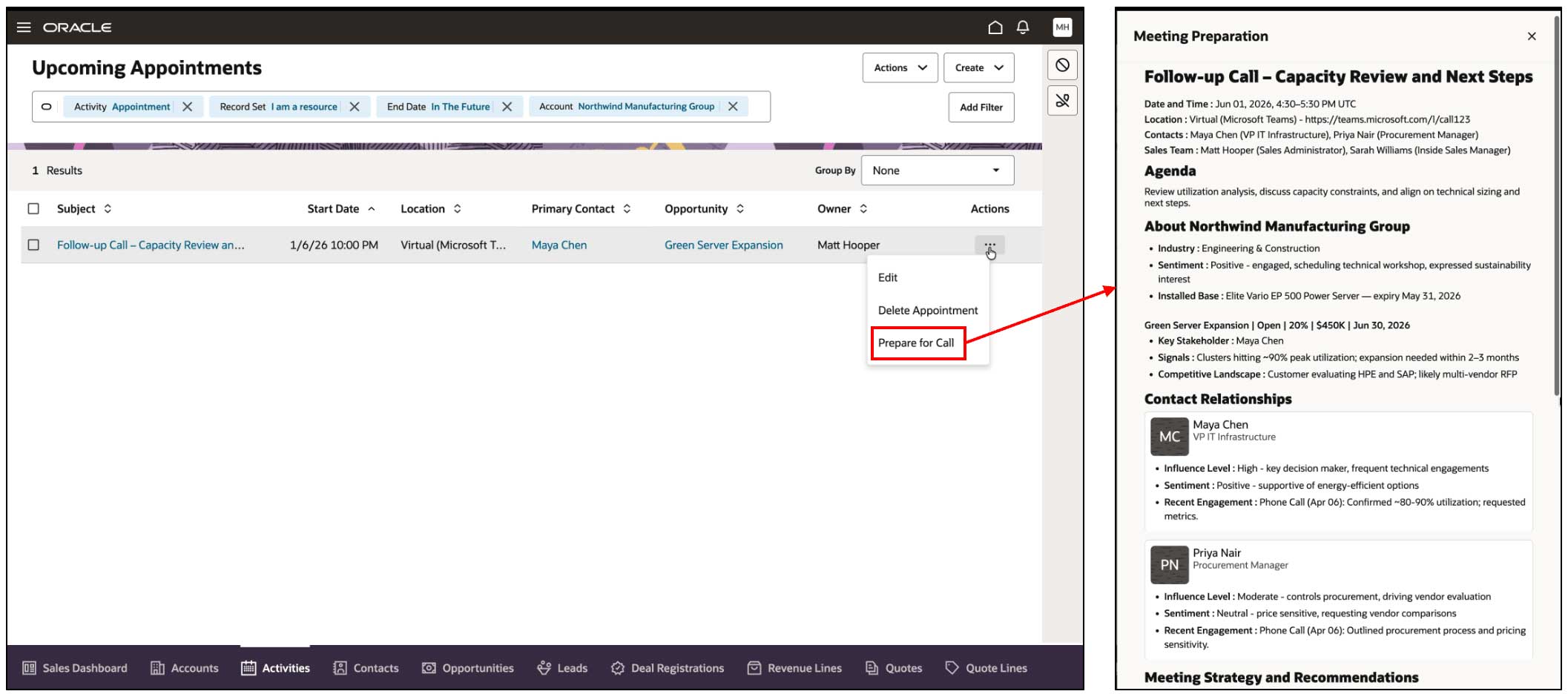
Sellers can now get an AI-generated brief before a customer meeting, pulling together the related account, opportunity or lead, contacts, recent activities, and email history into one place. Anyone who has sat down five minutes before a call trying to piece together context from four different tabs will see the value here immediately. Setup required.
Migrating Generative AI Features to AI Agents
Generative AI capabilities released in earlier updates — things like Writing Assistant and Composing Email — are moving from prompt-based generation to proper workflow agents in Agent Studio. A new feature toggle controls this in the CX Sales FSM task UI. If you've already built processes around the earlier prompt-based versions, it's worth checking how this migration affects them before you opt in.
Estimate Compensation Conversationally
Over in Sales Performance Management, participants and participant managers can now ask an AI agent, in plain language, how much incentive they'd earn from closing a particular deal. The agent looks at the participant's assigned plans and asks for whatever information it needs to give an accurate estimate. It's a small feature on paper but a genuinely useful one — compensation confusion is one of the more common sources of friction I see in IC environments. Setup required.
AI-Powered Renewal Navigator
This is a larger scale feature and, unusually for something at that impact level, it's auto-enabled — so it's worth understanding before it shows up rather than after. The Renewal Navigator agentic workflow identifies renewal-ready subscriptions, assesses renewal health, and guides each one through the most appropriate renewal path once the renewal process is set to agentic. For subscription businesses managing renewals at any real volume, this is the kind of capability that earns its place rather than just adding to the AI feature count.
AI Agent Studio Keeps Maturing
Common Technologies and User Experience carried a long list of AI Agent Studio updates in 26C — none of them headline features on their own, but together they tell you Oracle is treating Agent Studio as core platform infrastructure now, not an add-on. It reminds me a bit of a band soundcheck — no single adjustment is dramatic, but you need all of them in place before the show actually works. Here's what landed:
- Agent2Agent (A2A) Protocol — published agents can now collaborate with agents running on other platforms using a standard request-and-response model, including a shared lifecycle for long-running tasks. Setup required.
- Policy models — turn unstructured business policies into executable logic agents can use for consistent, deterministic decisions. Setup required.
- Reusable functions and reference blocks — define JavaScript function templates and reusable logic blocks once and reuse them across multiple workflows, cutting down on rebuilding the same logic repeatedly. Potential setup required.
- Long-term memory for agents — agents can now retain episodic memory of past interactions and user preferences, so responses get more personalised over time. Setup required.
- Long-running sessions — agent interactions can now span multiple days, so users can step away and rejoin a conversation in progress rather than starting over. Potential setup required.
- Refreshed Agent Studio interface — a new home page and general look and feel, though Marketplace and Monitoring and Evaluation still run in the earlier experience for now. Setup required.
- Bring Your Own LLM (BYOLLM) — you can now request enablement of additional supported large language models via a service request if the one you want isn't already in the model list. Setup required.
- Debugger — trace, test, and troubleshoot agentic flows in real time, with visibility into node execution, inputs, outputs, and LLM reasoning. Genuinely useful if you're building anything non-trivial in Agent Studio. Setup required.
- Multiagent and Return nodes — build flows with a supervisor agent coordinating specialised worker agents, and use Return nodes to exit a workflow branch cleanly rather than running through every remaining step. Potential setup required.
- Command line interface — developers can now create, edit, validate, debug, and deploy Agent Studio artifacts from a CLI rather than only through the UI. Potential setup required.
- Approval process channel — manage human approval nodes in agentic flows through a structured, reusable approvals framework instead of one-off configurations. Potential setup required.
None of these need urgent action on their own, but if your team is actively building in Agent Studio, it's worth working through the list — the debugger and reusable functions in particular will save real time.
Core Platform, Security and UX Features
Multifactor Authentication (MFA)
This is the one I'd flag first, and it's not really optional in the way most "larger scale" features are. If you're creating a new environment family from 25D onwards, your environments sit on Oracle Cloud Infrastructure Identity and Access Management, and your users will need to enrol in MFA to sign in. If this applies to you, plan the change management around it — sign-in changes have a way of generating support tickets if users aren't warned in advance. Potential setup required.
Quick Action Links on the Home Page
A small but larger-scale-flagged wording and behaviour change: the checkbox for adding a quick action to the home page is now labelled "Show as quick action link on home" rather than the old wording. If you've documented setup instructions or trained admins using the old label, update them. Potential setup required.
Redwood Appearance Editor — Accurate Brand Colour Rendering
Previously, custom brand colours in Redwood themes sometimes rendered as lighter or darker variations rather than the exact colour specified. That's now fixed — Redwood applies your exact primary colour as long as it meets accessibility contrast requirements. If your Redwood theme has looked slightly "off" from your brand guide, this is likely why, and it's worth revisiting your theme once this lands. Potential setup required.
Oracle Visual Builder Studio Enhancements
A handful of extensibility improvements for teams building custom pages, including the ability to specify arbitrary labels for region tree items in the Reorder Fields panel. Minor on its own, but useful if you're doing any meaningful amount of page customisation.
Configure Redwood List Page Fields Using Custom Field Templates
You can now apply a custom field template to control how a field displays on a Redwood list page — styling and colour-coding based on the field's value, such as showing lead rank in different colours by status. It's a genuinely useful bit of configuration for making list pages easier to scan at a glance, without resorting to a full customisation. Setup required.
Dirty Data Warnings in Redwood Sales
Administrators can now enable system-wide alerts that warn users before they navigate away from a page with unsaved changes. This is a small feature, but it's the sort of thing that quietly prevents a genuine amount of user frustration — I'd enable it in most environments. Configured via Visual Builder.
What's Notable and Different in Oracle Transactional Business Intelligence
Oracle continues to expand OTBI's data and analysis capability with each release. This update is auto-enabled, so there's nothing to configure, but it's worth reviewing what's changed if your team relies heavily on OTBI reporting.
Subscription Management Features
Profile-Based Subscription Visibility
You can now control which subscription products appear in a subscription contract header using profile options, rather than showing everything by default. Once configured, schedule the Recalculate Subscription Product Availability process to apply the change. Potential setup required.
Manage Subscription Coverage Calendars Using REST APIs
This closes a genuine gap — customers can have thousands of service coverage schedules, exceptions, and availability windows, but until now there was no REST API or import path to create them. If you're integrating Subscription Management with other systems, this is worth flagging to your integration team.
Process Subscription Lifecycle Actions Asynchronously
High-volume suspend and close operations that meet the async threshold criteria can now be processed asynchronously from Update 26C onwards, aligning behaviour with existing asynchronous processing elsewhere in the product. Useful if you're running subscription operations at real scale, where synchronous processing has been a bottleneck.
As always, I've only covered what I think are the highlights across these four modules. There's more detail in Oracle's official readiness documentation, so it's worth reviewing the full release notes yourself — particularly the AI Agent Studio updates if your team is actively building agentic workflows, and the MFA change if you're due for a new environment family.
If you'd like to talk through how any of these features might land in your environment, or want a hand thinking through the MFA change, I'm always happy to find time for a call or a coffee chat.
Links to Release Documentation
- Sales Force Automation What's New 26C
- Sales Performance Management What's New 26C
- Subscription Management What's New 26C
- Common Technologies and User Experience What's New 26C
Author: Kevin Stephens