Oracle Asset-Based Service: How It Flows, and Five Things Teams Get Wrong
I spend most of my time on Oracle Field Service and asset management engagements, and this particular pattern comes up more often every year — manufacturers and equipment providers who no longer just sell a machine, but sell the ongoing service of that machine. It is a genuinely good commercial model. It is also one of the more misunderstood things in the Oracle Fusion estate.
The misunderstanding is rarely about whether Oracle can do it. Oracle can. The trouble is that teams arrive expecting one application with one setup guide, and instead find capability spread across Installed Base, Fusion Service, Field Service, Service Logistics, Maintenance Cloud, Subscription Management and IoT — each with its own configuration, and several with more than one way of connecting to the others.
So before the pitfalls, here is the shape of the thing.
How the process actually flows
Asset-based service has four stages. The important structural point is that work can enter the chain two different ways, and both converge on the same execution path.
1. Work starts — two ways. The reactive route begins with a sensor reading crossing a threshold. That raises an incident, which raises a service request in Fusion Service. The proactive route begins with a maintenance program: a forecast falls due and Maintenance Cloud raises a maintenance work order. Different triggers, different modules, same asset record underneath.
2. Route to Field Service. However the work started, it has to become a schedulable Field Service activity. There are three ways that happens, and choosing between them is a real design decision rather than a default — which is point three below, and the single most common source of expensive surprises.
3. Execute. Field Service schedules the activity against technician availability, skills and work zones, dispatches it, and the technician completes the job on the mobile app — working through any structured workflow the implementation defines, then recording parts used and labour spent in a debrief.
4. Close. That debrief lands in Service Logistics, where charges are reviewed and posted. Coverage is checked against Subscription Management to decide what is actually billable. Posting then fans out into four separate outcomes at once — and understanding that fan-out is point five.
Then it loops. Completion data and meter readings feed back into the next forecast, which is what makes the proactive route progressively better informed rather than a fixed calendar.
Here is that flow on one page.
Two entry paths, one execution chain
Oracle asset-based service spans six modules. No single application owns it,
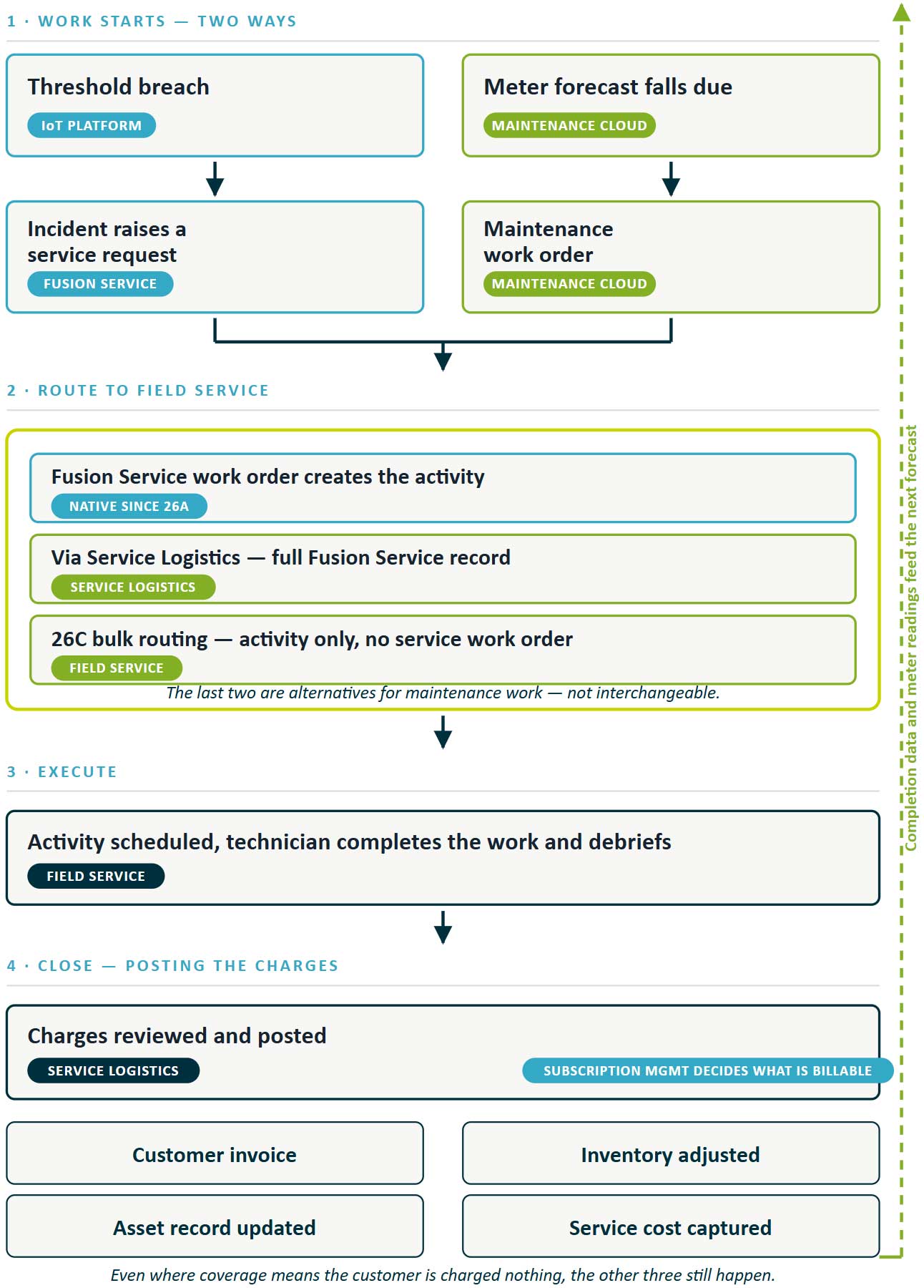
Asset-based service across the Oracle Fusion estate — two ways work starts, one chain that executes and closes it.
With that shape in mind, below are the five things I most often have to unpick. None of them are obscure. All of them are cheaper to understand before a design workshop than after one.
1. Oracle asset-based service is a pattern, not a product
There is no line item called "asset-based service". What exists is the way of working described above, and the spine holding it up is Installed Base.
An asset gets registered once in Installed Base. From that point, service requests, work orders, knowledge articles, warranty and service history all attach to that single asset record. The same asset model is shared across Supply Chain Management, Service Logistics, Service Contracts and IoT — not copied between them.
Oracle does use the term itself, incidentally. The 24B readiness note New Asset Based Service Layout With Service Profile, Bill-to Information and Service Address describes service structured around a Service Profile — a site location rolling up to an account, carrying its own assets, contacts and notes, with bill-to and service address captured once and then flowing through the service request, the work order, the debrief and into billing.
Practical consequence: if your design starts from a module rather than from the asset record, you will end up reconciling asset data between systems that were built to share it.
2. The assets are your customer's, not yours
This is the one that reframes everything, and it catches people with an enterprise asset management background hardest.
Most practitioners meet Oracle Maintenance Cloud in its original context: your plant, your fleet, your equipment, maintained by you for you. So when Maintenance Cloud appears in an asset-based service design, the natural assumption is that we must be talking about the same thing.
We are not. In asset-based service, the assets sit at the customer's premises and belong to the customer. Your client didn't buy that generator — their customer did. Your client is contracted to keep it running.
Fusion handles this with a single asset register rather than two. Customer assets and internally owned assets live in the same Installed Base structure; what distinguishes them is how the record is set up — a customer, an account, a customer site and a customer address location, versus an internal inventory organisation. And critically, a customer asset can still be maintenance-enabled: it can carry maintenance programs, generate work orders, and be assigned to a maintenance organisation.
Which gives you the shortest useful definition of the whole pattern: asset-based service is pointing enterprise maintenance tooling at assets you don't own. Nothing in Maintenance Cloud requires the equipment to be yours.
Two things follow. First, the prerequisite that actually matters is not ownership but enablement — the asset must be a maintenance-enabled item with full lifecycle tracking, in a maintenance-enabled inventory organisation. Get that wrong and it doesn't matter whose asset it is. Second, those customer assets are not on your client's fixed asset register, because they are not your client's capital. Teams that assume a tidy relationship between the operational asset register and Financials are usually thinking of the enterprise-asset case, not this one.
3. There are two roads from Maintenance into Field Service — and they are not interchangeable
Here is the design decision I would most want a team to make deliberately rather than by accident.
Once Maintenance Cloud has raised a work order, that work has to reach a field technician. There are two quite different ways for it to get there.
The first route goes through Service Logistics. A scheduled process reads the maintenance work order and generates a genuine B2B Service service request and work order, which in turn produces a Field Service activity. You end up with a full service record in Fusion Service.
The second route, introduced in 26C, is direct bulk routing from Maintenance into Field Service. It creates a Field Service activity — and that is all it creates.
Important: Oracle's documentation is explicit on this point — see Route Maintenance Work Order Operations Using Routing Plans in the Oracle Fusion Field Service Using Routing guide: "Oracle Fusion Field Service creates activities from Maintenance Work Order Operations, not from the Maintenance Work Order header."
Activities are created from the operation, not the header, and no Fusion Service work order is produced at all. Oracle also warns that if you already have Oracle Integration Cloud or custom integrations creating activities from maintenance operations, enabling bulk routing can produce duplicate activities. Check for this before you switch it on.
Nothing in the documentation says one route supersedes the other. They are alternatives, and the choice has real consequences — whether a customer-facing service request exists, what your reporting can see, and where your integration effort goes.
Bulk routing also carries eligibility rules worth knowing early. It applies only to released, single-asset work orders on a bulk routing plan — not continuous, immediate or urgent plans — with count point operations only, optional operations excluded, and no pre-existing activity. Multiple operations on one work order create separate activities each.
4. IoT does two different jobs, and only one of them creates work orders
Predictive maintenance demonstrations tend to blur two separate capabilities into one impression of intelligence. They are genuinely different, and conflating them leads to disappointed clients. Both of the paths below describe Oracle's own IoT applications, because that is what Oracle's integration documentation covers — see the note at the end of this section on using something else.
The reactive path does what people expect. An IoT threshold rule is breached, an incident is raised, and — where the rule is configured for it — a work order is created automatically in Maintenance Cloud. Incident event codes can be mapped to trigger specific maintenance programs. Sensor readings also sync daily into Maintenance Cloud as asset meter readings, so maintenance schedules can be driven by how hard an asset is actually being worked rather than by the calendar alone.
The interval optimisation path is a different animal. Maintenance data flows out to IoT Asset Monitoring, learning workflows analyse historical failure and replacement patterns, and the output is a recommendation to adjust maintenance intervals — which a maintenance manager then accepts, rejects or overrides.
That second path creates no work orders. It informs how you design your preventive maintenance programs; it does not act on its own. If a client believes they have bought a system that reschedules its own maintenance, this is the conversation to have early.
You don't have to use Oracle's IoT applications for any of this.
What Maintenance Cloud actually needs from an IoT layer is narrow: meter readings against an asset, and a trigger when a reading crosses a threshold. Both can be supplied by whatever IoT ecosystem your client already runs — a hyperscaler IoT service, a specialist industrial platform, or an existing plant historian — through REST APIs or Oracle Integration Cloud.
This matters commercially. Plenty of equipment businesses have already invested in sensors and a monitoring platform, and they are understandably reluctant to replace a working telemetry stack to satisfy an ERP programme. They don't need to. The asset-based service pattern is indifferent to where the readings come from.
What you give up by going third party is the pre-built integration and the interval optimisation described above, which becomes a build decision rather than a configuration one. Price that honestly at scoping rather than discovering it in build. And whichever direction you go, confirm current product availability and licensing directly with Oracle before you assume any specific IoT application is in scope.
5. Service Logistics is carrying more than you think
Service Logistics is the module most likely to be waved away in scoping, usually because it never appears as the star of a demonstration. It is, however, doing a great deal of the work.
Parts do not teleport to technicians. Somebody has to own the part requirement becoming a transfer order, the pick release, the ship confirm out of a parts warehouse, and the receipt into the technician's own stock. If that is not Service Logistics, it is a spreadsheet and a phone call.
It also owns the commercial close. Technician debriefs land in Manage Charges and Estimates, and posting those charges fans out into four places at once: it generates the customer invoice, adjusts inventory, updates the Installed Base asset configuration so the record reflects the part now fitted, and captures the service cost internally.
That fan-out matters more than it sounds. Even where a job is fully covered by warranty or a service plan and the customer is charged nothing, the inventory movement, the asset configuration update and the internal cost capture all still happen. Zero on the invoice is not the same as nothing happening.
And field repair is not the only shape this takes. Service Logistics also supports depot repair, where the asset travels to a workshop instead of a technician travelling to the asset — local warehouse to distribution centre to repair depot, and the whole journey back. Clients with high-value or specialist equipment ask for it. It carries real configuration overhead in inventory organisations, subinventories, inter-organisation transfers and shipping methods, so treat it as a design workstream rather than a checkbox.
What this means when you're scoping
None of the above is a warning against the pattern. Asset-based service is one of the more valuable things an equipment business can do with Oracle, and the platform supports it properly.
But the scoping questions that actually de-risk it are narrower than they first appear. Are the assets maintenance-enabled, and in the right kind of inventory organisation? Which of the two roads from Maintenance into Field Service are we taking, and have we checked for duplicate activity creation? Whose IoT platform are we actually feeding this from, and is the client clear about which capability creates work and which only advises? And has anyone owned the parts and charges flow, or has it quietly been assumed away?
Answer those four before design starts and most of the expensive surprises disappear.
One closing note on currency. Oracle moves this area quarterly, and some of it has moved recently — the standard Fusion Service to Fusion Field Service work order integration became native in 26A, no longer requiring Oracle Integration Cloud, while Maintenance Cloud still connects through the Oracle Maintenance Accelerator. Always check the current readiness material for your target release rather than relying on a design pattern from a project two years ago.
Further reading
The official Oracle documentation below is where I would start for the integration detail. Release readiness notes are updated quarterly, so check the version that matches your target release.
- Integrating Fusion Service with Field Service
- Enable Service Logistics to Oracle Fusion Field Service
- Set Up the Oracle Maintenance Accelerator for Oracle Fusion Field Service
- Unified Oracle Fusion Field Service and Oracle Fusion Service Flows (26A readiness)
- Unified Workflows Across Fusion Field Service and Fusion Service (25D readiness)
- Using Routing (Oracle Fusion Field Service) — see "Route Maintenance Work Order Operations Using Routing Plans"
- Oracle Maintenance to Oracle Fusion Field Service Work Order Sync
- Administering Oracle Fusion Field Service
Why Kyte?
Kyte Consulting was founded in 2021 by ex-Oracle Consulting leaders, and that background is the reason a pattern like this one is familiar rather than novel to us. We have 50+ Oracle specialists across Melbourne, Sydney, Canberra and Perth, we are 100% Australian owned, and we are 100% referenceable — every client we have worked with will take your call.
Our delivery model runs on AI, which in practice means the unglamorous parts move faster: discovery workshops captured and structured as they happen, requirements and test coverage documented in hours rather than weeks. That leaves our senior consultants spending their time on the decisions that actually shape your implementation — like which of those two roads into Field Service you should be taking.
If you are scoping asset-based service, or you have inherited an implementation and are not certain which pattern it is using, start a conversation with our Field Services and Asset Management team.
Deliver faster. With Kyte AI.
Author: Alf Martin, Capability Lead – Field Services and Asset Management, Kyte Consulting