What’s New in Oracle Fusion Field Service – 25D Update

This release continues Oracle’s strategy of unifying service workflows while increasing operational intelligence and automation in field service environments.
Let’s take a closer look.
Unified Workflows with Oracle Fusion Service
One of the most impactful 25D enhancements is the deeper native integration between Field Service and Oracle Fusion Service.
With this release:
- Work Order data from Fusion Service can now be displayed directly within the Field Service interface.
- Administrators can configure which Work Order fields and Descriptive Flexfields (DFFs) appear in activity screens such as Activity Details and Start Activity.
- Certain fields (including supported DFFs and Field Service Notes) can be edited from the mobile interface, while others remain read-only to preserve data governance.
- Address sourcing logic improves geocoding by intelligently combining activity and work order data.
-
Work Order fields can now participate in configuration elements such as:
- Activity Search
- Duration Keys
- Travel Keys
- Work Zone Keys
Business Impact
Technicians gain real-time contextual visibility without switching applications, improving productivity and reducing manual reconciliation between systems.
Enhanced Integration with Oracle Maintenance Cloud
The 25D release strengthens the integration accelerator between Field Service and Oracle Fusion Cloud Maintenance.
Enhancements include:
- Maintenance organizations syncing automatically as buckets in Field Service.
- Maintenance resources mapping to work skills, work centers, and tool resources.
- Direct retrieval of mobile worker resource details from Maintenance Cloud.
- Scheduled synchronization flows to ensure data consistency across systems.
Business Impact
Improved resource alignment and reduced integration overhead allow organizations to maintain a single source of truth for maintenance and field operations.
Smarter Booking with Dynamic Dependencies API
The new bookingFieldsDependencies REST API enhances integration reliability when calling the showBookingGrid service.
Instead of hardcoding required booking parameters, the API now dynamically returns all required fields based on live configuration, categorized into:
- Common
- Duration
- Travel time
- Work zone
- Work skill
Business Impact
Integrations become more resilient to configuration changes, reducing booking errors and eliminating manual integration updates when dispatch rules evolve.
Other Notable Enhancements
While integration updates headline the release, several incremental improvements in 25D deliver tangible operational gains.
Simplified User Types Management
User type configuration has been streamlined, making it easier for administrators to define and maintain dispatcher, technician, and administrative roles.
Improved clarity in setup reduces configuration errors and simplifies governance in large deployments spanning multiple regions or business units.
Better role management enhances segregation of duties and ensures users only access relevant functionality.
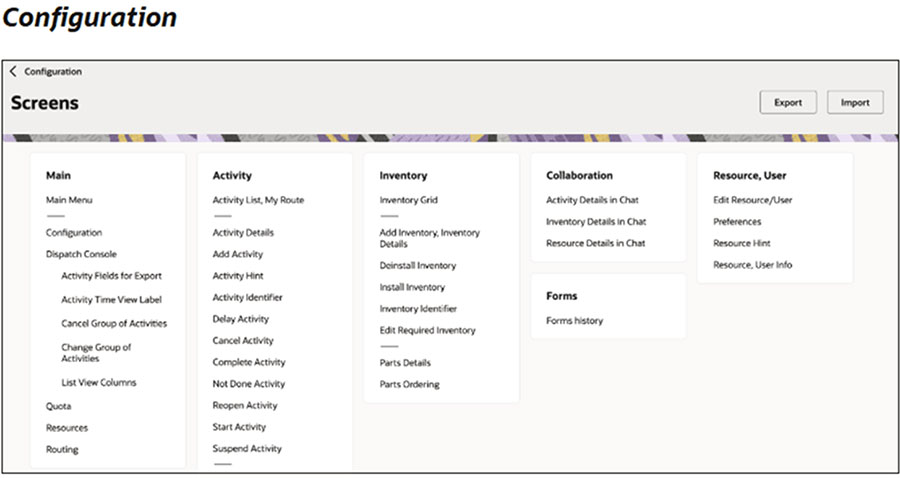
Bulk Inventory Upload Enhancements (Serialized Inventory)
Serialized inventory uploads now benefit from improved validation logic, better serial number handling, and enhanced performance during large batch imports. Accurate trunk stock tracking reduces dispatch delays, minimizes manual corrections, and improves first-time fix rates.
Assignment Assistant Improvements
Dispatchers gain enhanced usability and responsiveness in the Assignment Assistant tool, including:
- Better activity reassignment visibility
- Improved filtering capabilities
- More responsive performance when moving work between resources
Dispatch teams can now react more quickly to last-minute schedule changes, technician
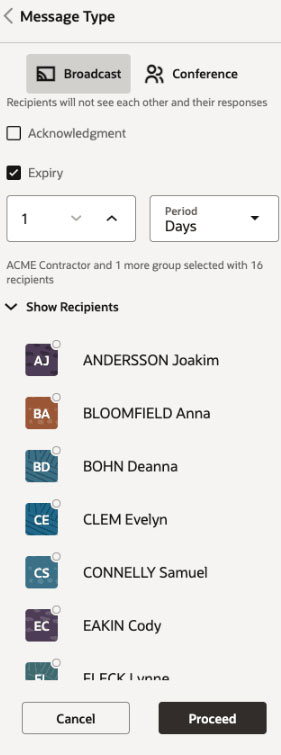
Enhanced Collaboration Group Messaging
Internal collaboration tools have been refined with improved message visibility and conversation organization. Technicians and supervisors can coordinate more effectively without relying on external messaging platforms, supporting auditability and compliance.
iOS Voice Command Enhancements
Expanded voice command capabilities on iOS devices allow technicians to perform more actions hands-free. Voice-enabled workflows improve safety, reduce data entry friction, and increase productivity in constrained or high-risk service environments.
Overall Business Impact of 25D
The 25D update demonstrates Oracle’s continued focus on:
- Cross-application unification
- Intelligent integration
- Mobile-first productivity
- Administrative simplification
- Operational agility
While some updates may appear incremental individually, collectively they enhance SLA compliance, technician utilization, dispatch efficiency, and customer satisfaction.
Final Thoughts
The 25D release of Oracle Fusion Field Service reinforces Oracle’s strategy of embedding intelligence directly into operational workflows — reducing integration complexity while increasing real-time visibility and responsiveness.
Organizations leveraging both Service and Maintenance Cloud will particularly benefit from tighter synchronization and unified data models.
Full features released can be reviewed at Oracle.
Author: Alf Martin
Alf is a digital transformation and Oracle cloud specialist, serving currently as Capability Lead at Kyte Consulting, Alfred is driving adoption and capability around Oracle’s Asset-Based Service flows — a set of business processes central to organisations with intensive asset operations such as utilities, ports, mining, and similar industries. In this capacity he specialises in Oracle Fusion modules that support these flows, including Maintenance Cloud, Inventory, Service, Subscription Management, Field Service and Service Logistics models, helping organisations connect operational data with service execution. This work builds on his practical experience in both ERP and CX domains to deliver strategic outcomes and business value.